
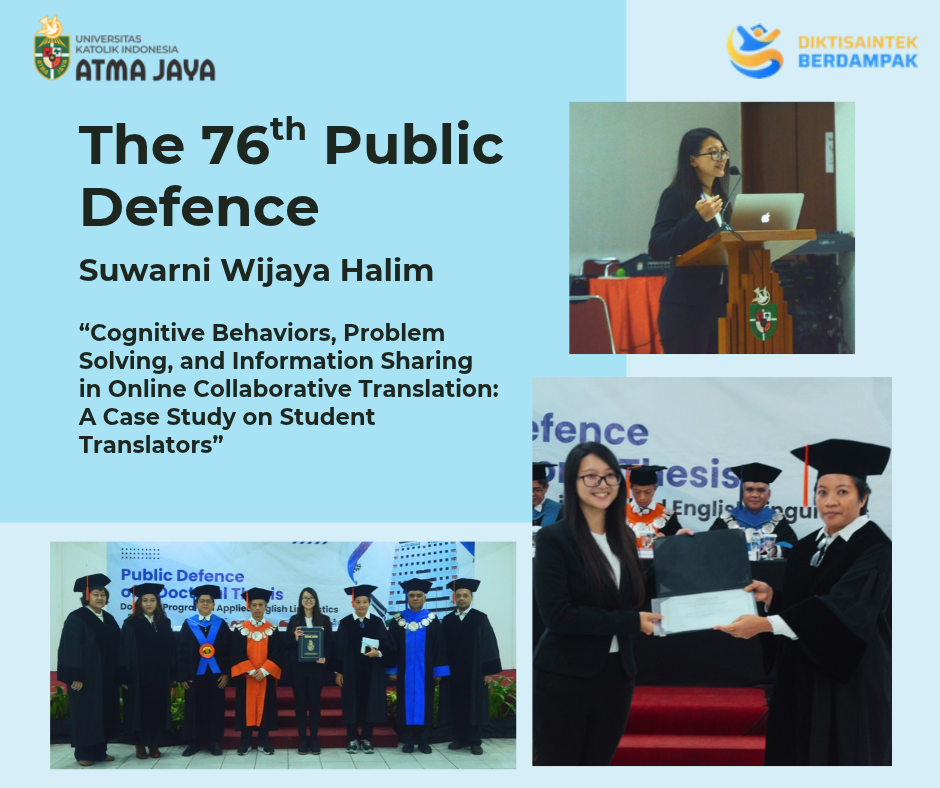
Recently, the notion of collaboration in translation has received much attention in both the field of translation studies and professional translation landscape. In the field of translation studies, many experts pointed out that in contrast with the picture of lone fighters slaving away to produce high quality translation, translators actually collaborate with a number of parties and receive support from various tools and artifacts in different stages of translation process. In conjunction with that, in the professional translator landscape, many translators work together with another translators to keep up with the translation demands through the use of technology. In short, the topic of collaboration in translation has been very popular in both academic and practical translation fields, and as a result, much research on various angles of collaborative translation has been conducted. However, studies on the process of collaborative translation in an online environment have been scarce, specifically on the topics of cognitive behaviors, problem solving, and information sharing. Studies on the translation process are crucial as they could provide information on the translators’ point of view and way of thinking when translating, which could be used further to improve the translation result and inform the practice of translator training. There have been few studies which focus on deciphering the translator’s cognition and mind during the process of translation. However, many of those studies only involve individual translators. Studies which focus on a cluster of translators working together to produce translation are lacking, particularly those that discuss the translators’ cognition. Therefore, the present research aims to fill that gap by exploring and investigating the cognitive behaviors, problem solving, and information sharing of student translators in the context of online collaborative translation by using theories from Engliana (2017; 2019; 2026), Bales and Strodtbeck (1951), Nitzke (2019), Hansen and Järvelin (2005), Karunakaran et al. (2013), and Shah (2014). Several research instruments, namely questionnaire, translation task from Indonesian into English, translation assessment criteria, and observation on Collaborative Translation Protocol (CTP) were used to acquire the data on the student translators’ actions, behaviors, and utterances during the process of translating. The data generated from the data collection process were analyzed in order to identify the student translators’ cognitive behaviors, joint problem solving, and information sharing when translating collaboratively in an online environment. The result generated from this study revealed that the student translators involved in online collaborative translation demonstrated similar stages of translation process and exhibited similar cognitive behaviors as individual translators, i.e. the stages of Comprehending, Transfer, Restructruring and Editing. In addition, they exhibited most cognitive behaviors associated with each stage just like individual translators. However, while the cognitive processes in individual translators happened silently, the processes occurred aloud in online collaborative translation through verbalized exchanges of information, negotiation, and argumentation. The translation stages in online collaborative translation were manifested in numerous small, segment-based cycles where the student translators aimed to complete all stages for a single segment before moving to the next, rather than one large continuous cycle over the entire text as seen in the case of individual translators. In terms of joint problem solving in online collaborative translation, the student translators navigated the stages of problem solving by transforming individual mental acts into collective ones. They would attempt to solve one translation problem before moving on. However, in the case they could not agree on the solutions, they would prefer to postpone solving the problem and coming back to it later. In terms of information sharing, the student translators performed Parallel Searching and Push Sharing to share information with each other, and after the sharing process, a Shared Mental Model was established. The research argues that translator training should include collaborative translation models to match modern industry standards. By utilizing digital tools and CTP, educators can better observe students’ problem-solving and reasoning in real-time. This approach moves the focus beyond basic linguistic skills toward collective intelligence, digital literacy, and the interpersonal communication required in today's professional landscape.
We would like to convey our sincere and heartfelt congratulations to Dr.Li. Suwarni Wijaya Halim for this achievement. We look forward to her future success and valuable contributions to the field of English applied linguistics.
Jl. Jenderal Sudirman RT 02 RW 04 No. 51,
Karet Semanggi, Jakarta 12930
Whatsapp: +62 812-9898-8960
Phone. (62-21) 5727615, 5703306, 5708823
Ext. 356 (Operator), 123 (Student Registration Information), 413 (Marketing), 359 (Admission), 347 (Corcomm)
E-mail: corcomm@atmajaya.ac.id





Copyright © 2023 Unika Atma Jaya. All Rights Reserved.
Privacy Policy