
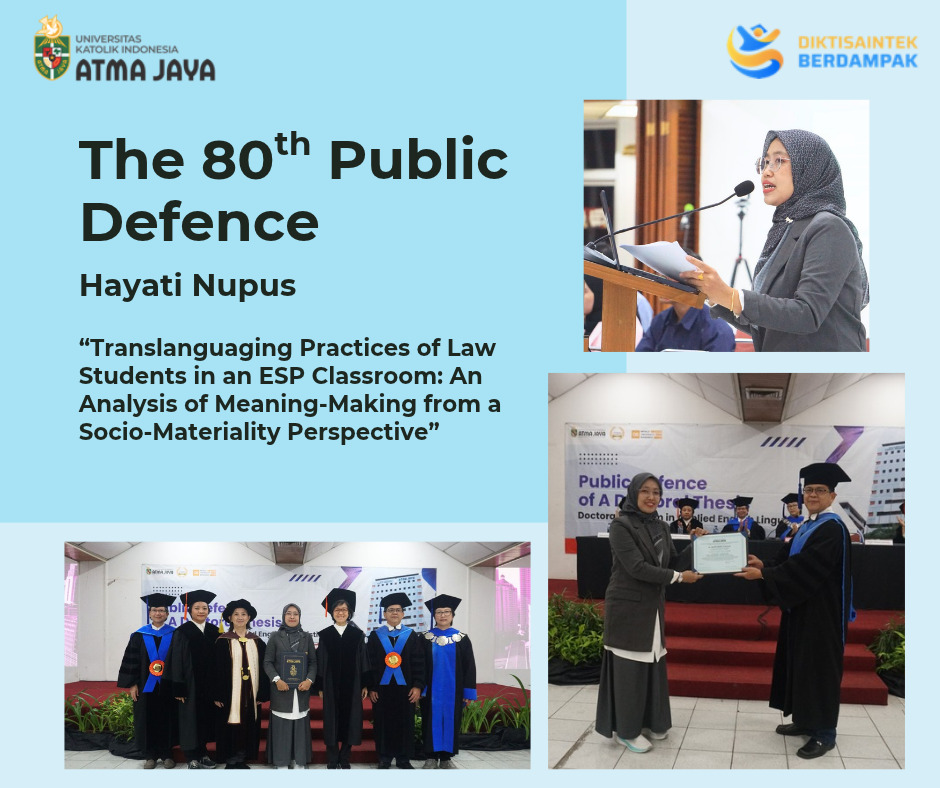
This study investigates how undergraduate law students use translanguaging practices to support meaning-making in an English for Specific Purposes (ESP) classroom. The study responds to the challenge faced by multilingual Indonesian law students who are expected to discuss complex legal topics in English while also negotiating difficult legal concepts, unfamiliar terminology, and unequal levels of English proficiency. Two questions guide the study: (1) How do the law students in the ESP classroom interact to support meaning-making through their translanguaging practices from a socio-materiality perspective, including human and non-human actors? and (2) How do students view their translanguaging experiences in the ESP classroom?
The theoretical framework integrates translanguaging theory, Socio-materiality, and Actor-Network Theory. These perspectives enable the analysis to move beyond language choice alone and to examine how people, tools, texts, bodies, digital devices, and classroom artefacts jointly shape classroom interaction.
A qualitative research design was employed. The participants were fifteen undergraduate students enrolled in one intact ESP Legal English class at a private university in Banten. The data consisted of video-recorded group-work interactions from seven classroom meetings, stimulated-recall interview transcripts, and learning artefacts used during ESP speaking activities. The classroom topics included human rights, domestic violence, Indonesian courts, unregistered marriage and illegitimate child rights, juvenile delinquency, terrorism and law enforcement, and law and order. The learning artefacts included mobile phones, translation applications, dictionaries, notes, printed group-written tasks, laptops, legal texts, PowerPoint slides, and the whiteboard.
The findings show that students used translanguaging to clarify legal concepts, contextualize abstract ideas, build arguments, justify positions, negotiate meaning with peers, and sustain participation in discussion, presentations, and debates. Indonesian and English were not used as a separate system but as part of an integrated repertoire. English was commonly used to frame legal terminology and academic claims, while Indonesian was often used to explain local legal realities, provide examples, express stance, and make arguments more meaningful for peers.
The findings also show that meaning-making was mediated by socio-material networks. Human actors, including peers and the lecturer, supported understanding through questioning, confirmation, feedback, and collaborative reasoning. Non-human actors, such as mobile phones, translation applications, dictionaries, notes, printed tasks, legal texts, laptops, slides, and the whiteboard, helped students retrieve vocabulary, organize arguments, check meaning, and maintain the flow of interaction. Embodied resources, including gestures, also contributed to how students expressed alignment, uncertainty, confidence, and emphasis.
Students viewed translanguaging as a helpful learning resource. They reported that the use of Indonesian, English, peer support, and learning artefacts helped them understand legal content, express idea more clearly, reduce anxiety, and participate more confidently in ESP speaking tasks. The study concluded that translanguaging in legal ESP classrooms is a situated, multimodal, and socio-material practice. Meaning-making emerges not from language alone, but from the coordinated interaction among students, lecturer, languages, artefacts. technologies, and classroom activities.
We would like to convey our sincere and heartfelt congratulations to Dr.Li. Hayati Nupus for this achievement. We look forward to her future success and valuable contributions to the field of English applied linguistics.
Jl. Jenderal Sudirman RT 02 RW 04 No. 51,
Karet Semanggi, Jakarta 12930
Whatsapp: +62 812-9898-8960
Phone. (62-21) 5727615, 5703306, 5708823
Ext. 356 (Operator), 123 (Student Registration Information), 413 (Marketing), 359 (Admission), 347 (Corcomm)
E-mail: corcomm@atmajaya.ac.id





Copyright © 2023 Unika Atma Jaya. All Rights Reserved.
Privacy Policy