
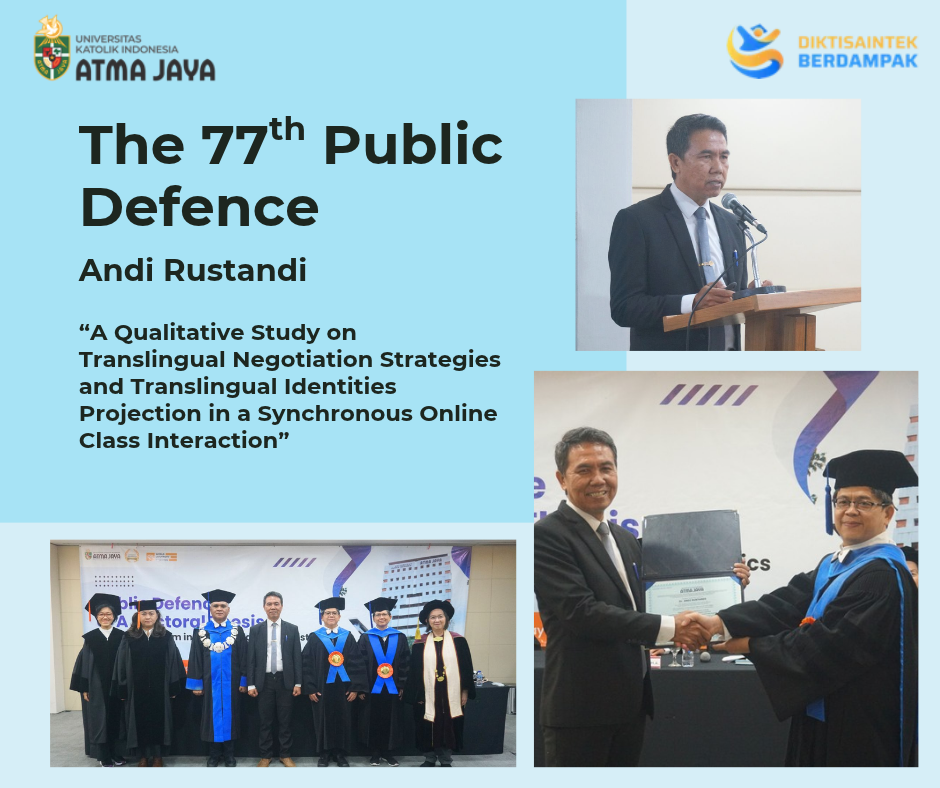
This study investigates the translingual negotiation strategies and translingual identity projection in synchronous online classroom interaction. These two notions believe that translingual deploy negotiation strategies not only for meaning negotiation but also for the projection of language identity development during classroom interaction. Concerning this conception, this study employs two research questions: (1) How do the participants (English teachers and Indonesian students) enact their translingual negotiation strategies in a synchronous online classroom interaction? (2) What factors influence the wat the teachers and students enact the translingual negotiation strategy and project their translingual identity? This study adopts a qualitative approach using narrative inquiry classroom ethnography, as proposed by Merriam (2019). To collect the data, this study used seven observations of several course subjects in a synchronous online Zoom classroom, eight in-depth interview questions, and ten short reflective questionnaires from lecturers and students. The participants of the study were two English lecturers from the Philippines and one English lecturer from Thailand. The study also involved 5 of the 30 students in the English department at one private university in Indonesia that offers an international credit transfer program. Tai's Multi-Modal Conversation Analysis (2023) served as the primary analytical framework to examiner how linguistic, embodies, and digital semiotic resources interact in the process of translingual negotiation, while the framework of meaning negotiation strategies proposed by Suresh Canagarajah (2013) was employed as a complementary lens to further interpret the strategic dimensions of translingual practices. However, the Creative Analytical Process (CAP) proposed by Richardson (2004) was employed to analyze the interview and questionnaire. The findings reveal that lecturers' and students' translingual negotiation strategies are enacted through envoicing, interactional negotiation, recontextualization, and entextualization, supported by embodies and digital resources, particularly emojis, as key tools for meaning making. These practices are shaped by linguistic repertoires, cultural pragmatics, social and digital-spatial contexts, power relations, and digital embodiment. influencing participants' identity projection. Accordingly. the study highlights the importance of pedagogical approaches that legitimize hybrid language practices, support code-switching and embodiment, and leverage strategic digital tools to enhance engagement, reduce participation barriers, and affirm identities in virtual classrooms.
We would like to convey our sincere and heartfelt congratulations to Dr.Li. Andi Rustandi for this achievement. We look forward to his future success and valuable contributions to the field of English applied linguistics.
Jl. Jenderal Sudirman RT 02 RW 04 No. 51,
Karet Semanggi, Jakarta 12930
Whatsapp: +62 812-9898-8960
Phone. (62-21) 5727615, 5703306, 5708823
Ext. 356 (Operator), 123 (Student Registration Information), 413 (Marketing), 359 (Admission), 347 (Corcomm)
E-mail: corcomm@atmajaya.ac.id





Copyright © 2023 Unika Atma Jaya. All Rights Reserved.
Privacy Policy